
Dashboard
New Transcription
0 min
How do you want to transcribe?
Upload Audio
Estimated cost: 0 min
Free minutes are included. Upload a file or record audio to start.
Convert MP3 to text on this page: choose an MP3, set the spoken language, and start a real transcription task in the workspace below. When the draft is ready, review the wording and timestamps, fix names and numbers, copy the passages you need, and download the edited transcript as TXT or export another format. Verified new accounts start with the current transcription-minute allowance, shown before you begin.
Dashboard
How do you want to transcribe?
Free minutes are included. Upload a file or record audio to start.
Verified accounts use the current Whisper AI transcription allowance. Audio is processed by the active cloud transcription provider, and finished tasks are saved in your recordings with the mp3-to-text source tag.
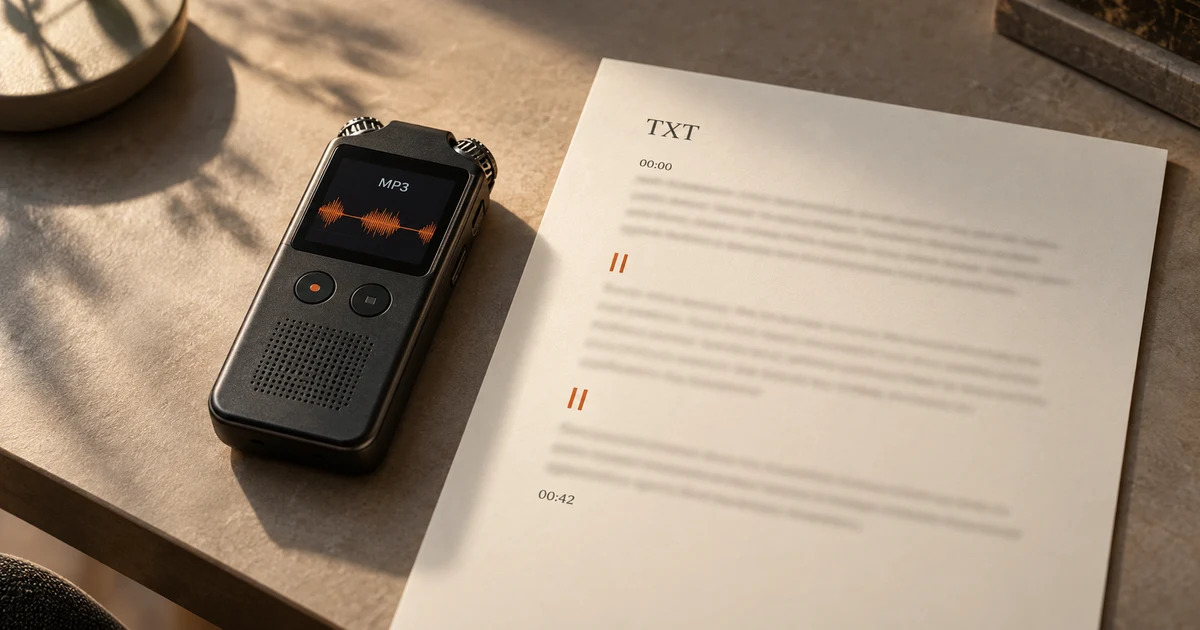
This is the expected edited result for our own 64-second English narration: the speaker introduces himself, gives a project update with several numbers, and pauses twice. It is an illustrative example prepared without spending transcription credits, not a captured provider transcript. The timestamps show the editor view; a plain TXT export contains the text without them.
Source: original 64-second MP3 narration (English, locally synthesized)
Edited TXT result
The sample is our own original narration, not a customer recording, and the transcript above is the expected edited text rather than a captured provider output. A machine draft can mishear names and numbers, so check the edited TXT against the audio before you publish or quote it.
Start from the MP3 itself and let the workspace create a timestamped draft you can correct. The page keeps the task, the editor, and the download in one place.
Upload an MP3 from this device, record audio in the browser, or import a supported public media URL. When you know the spoken language, choose it before starting so the recognition pass is not guessing from a short sample. One file per task keeps the timing and the transcript easy to check.
The workspace checks the audio, states the current minute and file-size limits before the task runs, and shows the credit cost against your balance. Nothing is generated until you start the task, so opening the page never spends transcription minutes.
When the draft is ready, replay the timestamps and scan for names, numbers, product terms, and passages affected by background noise or overlapping speech. The first result is a draft to correct, not a finished document.
The editor keeps your corrections with the task, so the file you download matches the version on screen instead of an older machine draft.
Correct names, numbers, acronyms, and specialist vocabulary directly in the transcript text. Replay the timestamp for any uncertain passage before changing it, and keep the spoken meaning rather than smoothing the speaker into different words.
Select and copy the passages you need for notes, an article, or a summary without leaving the page. Keep the timestamps if you plan to quote the recording, so a reviewer can find the original moment.
Download TXT for a plain, portable transcript, or use the workspace exports for DOCX, JSON, SRT, and VTT when the words need to become a document, structured data, or captions. Download after saving so the exported file matches the current version.
MP3 is the format many recorders and phone apps produce, so the same workflow covers quick voice notes and longer interviews with a few checks.
A short voice memo transcribes quickly and is useful for capturing an idea before it is lost. Speak close to the microphone, avoid music beds, and name people and places clearly the first time so the draft is easier to correct.
For an interview, start with the clearest copy of the audio, choose the spoken language, and enable speaker separation only when the recording really contains more than one voice. Generated speaker labels group passages; they are not verified identities, so rename them after checking the recording.
If you only need a playable audio file, use a format converter instead of spending transcription minutes. If the source is a video, use the video to text tool so the audio track is handled with the same transcript and export pipeline.
Comparison describes the checked pages at a high level. It does not repeat competitor pricing, ratings, certifications, or accuracy claims, and naming a product is not an endorsement.
| Decision factor | Whisper AI | Notta | Happy Scribe |
|---|---|---|---|
| Starting from an MP3 | Upload an MP3 from this page, record audio in the browser, or import a supported public media URL | Confirm the current upload, recording, and URL options on its live tool | Confirm the current upload, recording, and URL options on its live tool |
| Editing before export | Fix wording, replay timestamps, copy passages, and keep edits saved with the task before downloading | An editor is offered; confirm which edits the current plan allows | An editor is offered; confirm which edits the current plan allows |
| Download formats | TXT download, plus DOCX, JSON, SRT, and VTT from the same transcript | Confirm the live export list and any plan gating | Confirm the live export list and any plan gating |
| Where the task lives | The finished task is saved in your recordings and tagged with its mp3-to-text source | Confirm how the live product stores and reopens projects | Confirm how the live product stores and reopens projects |
| Trying the workflow | Verified new accounts start with the current transcription-minute allowance, shown before the task runs | Check the current free and paid plan terms | Check the current free and paid plan terms |
Whisper AI is the strongest fit when you want to start from an MP3, see the transcript and its timestamps in an editor, keep the task with a traceable source, and download the edited text without switching to a separate workspace. Check each product's live terms before processing a long or confidential recording.
Yes. When the draft is ready, open the transcript in the workspace, replay any timestamp, and correct names, numbers, and wording directly. Your edits are saved with the task, and the TXT or other export is built from the version you saved, so the download matches what you reviewed on screen.
Choose the spoken language in the workspace before you start the task. Setting it up front helps when the clip is short or the audio is noisy, because the recognition pass is not guessing the language from a small sample. Leave it on automatic only when you genuinely do not know the language.
Yes, once a task has been created. Signing in, returning from a recharge, or refreshing restores the task and its status instead of starting a second transcription, so you are not charged twice. If a refresh happens before the task is created and the browser no longer holds the local file, choose the file again to start.
Yes. MP3 is a common output for phone recorders and interview apps, so a voice memo or an exported interview file can be uploaded directly. For interviews, choose the spoken language and enable speaker separation only when the recording really has more than one voice; the generated labels are voice groups, not verified identities.
The page checks the media rather than trusting the extension. A file that is renamed to .mp3 but contains unreadable or unsupported audio fails with a clear message instead of producing a meaningless transcript, so keep the original recording and export a valid MP3 or another supported format.
This is a cloud transcription workflow, so the audio you submit is handled by the active transcription provider and stored so the task can be processed and reopened. Review the privacy policy before uploading confidential, medical, or client material, and avoid uploading recordings you are not authorized to process.
Written and checked by the Whisper AI Editorial Team · Last reviewed 2026-09-22 · Editorial policy